- Success Skill
- Posts
- Your past is literally making your decisions for you.
Your past is literally making your decisions for you.
Here's what's running in the background, and how to catch it.

Success Skill
April 06, 2026
In partnership with

Hi friend,
Think about the last time you reacted to something in a way that surprised even you.
Maybe someone said something small and you went quiet for the rest of the day. Maybe an opportunity showed up and instead of feeling excited you felt this strange anxiety you couldn't explain. Maybe someone got close to you and without thinking, you found a way to create distance.
You didn't choose those reactions.
Something underneath chose them for you.
Most people go through their entire lives making decisions they think are rational, logical, based on what's in front of them right now, without ever realising that a huge portion of those decisions aren't coming from the present at all. They're coming from things that happened years ago, sometimes decades ago, that your brain quietly filed away as rules for how the world works.
This is not a therapy concept. This is literally how your brain is built.
Every time something happened to you as a kid, as a teenager, as a younger version of yourself, your brain ran a pattern recognition process. It logged the situation, logged the outcome, and stored a shortcut. Next time something similar happens, it doesn't think, it just runs the shortcut. Faster, more efficient, no conscious effort required.
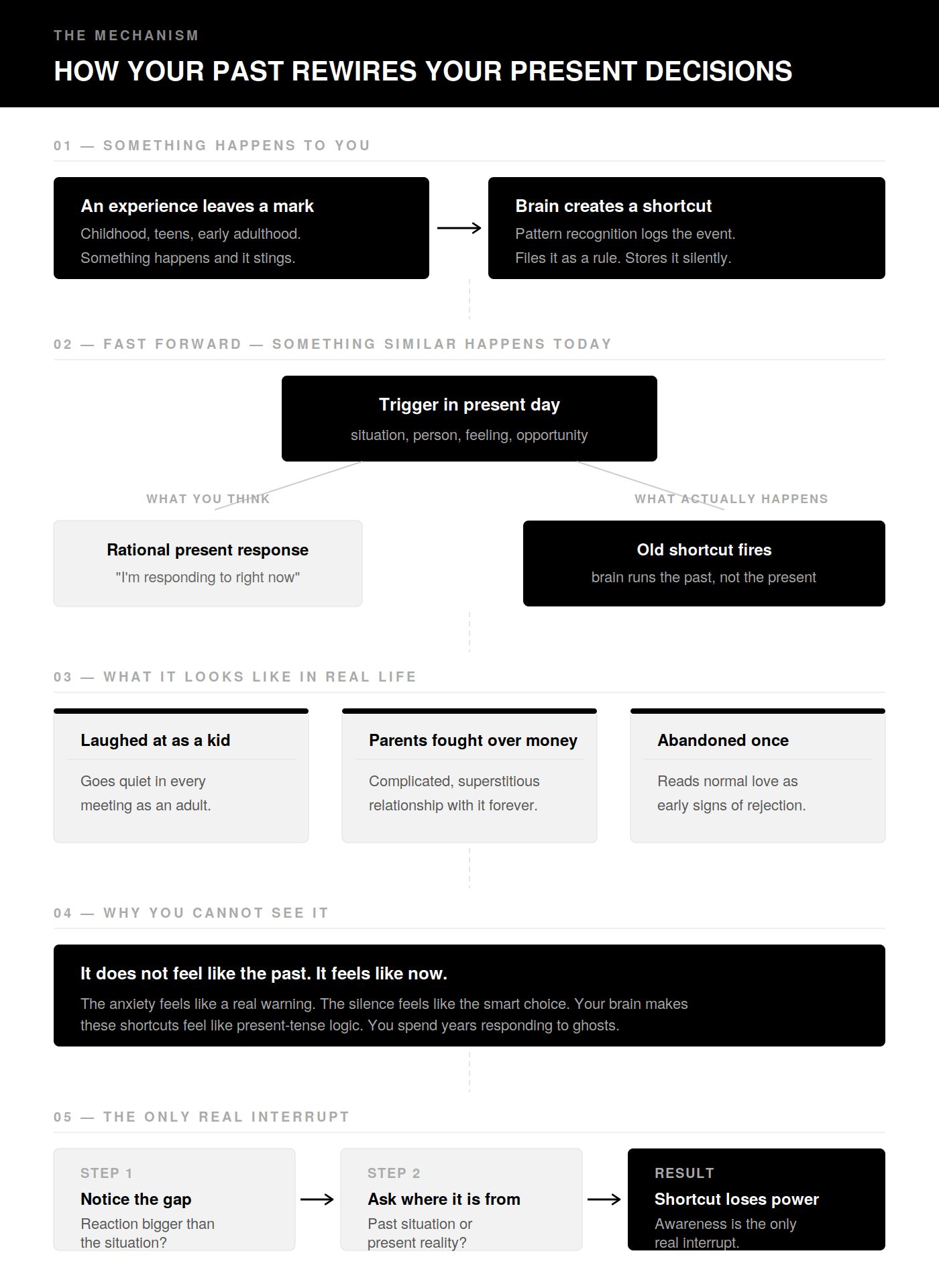
The problem is that the shortcut was written by a version of you that had far less information than you do now.
A kid who got laughed at for speaking up in class grows into an adult who goes quiet in meetings without knowing why. Someone who watched their parents fight about money develops a complicated, almost superstitious relationship with it that they spend years trying to understand. A person who got abandoned once, in whatever form that took, starts interpreting normal behaviour from people they love as signs that it's about to happen again.
None of that is weakness. None of it is something to be ashamed of.
It's just old code running in a new situation.
The reason it's so hard to catch is that it doesn't feel like the past. It feels like now. It feels like a rational response to what's actually happening. The anxiety feels like a real warning. The distance you create feels like self-protection. The silence feels like the smart choice. Your brain is so good at making these shortcuts feel like present-tense logic that you can spend years responding to ghosts without realising the room is empty.
So what do you actually do with this?
The first step, and honestly the hardest one, is just learning to pause when a reaction feels bigger than the situation deserves. Not suppressing it, not trying to talk yourself out of it, just noticing that there's a gap between what happened and how strongly you're responding to it. That gap is usually where the old wiring is.
When something small makes you disproportionately angry, ask where you've felt this before. When an opportunity scares you more than it should, ask what you're actually afraid of underneath the surface reason. When you pull away from someone for no clear reason, ask whether you're responding to them or to someone from a long time ago who isn't even in the room.
You're not broken. You're just running outdated software.
The people who seem to have their emotional responses figured out, the ones who seem calm in situations that would wreck most people, aren't built differently. They've just done the work of going back and reading the old code. Not to delete it, you can't do that, but to understand it well enough that it stops running automatically.
Because awareness is the only real interrupt.
Once you can see the shortcut for what it is, once you can name it in the moment, it loses most of its power over you. It doesn't disappear overnight but it stops being invisible, and invisible is the only way it can fully control you.
Your past is not your fault.
But at some point, understanding it becomes your responsibility.
Every headline satisfies an opinion. Except ours.

Remember when the news was about what happened, not how to feel about it? 1440's Daily Digest is bringing that back. Every morning, they sift through 100+ sources to deliver a concise, unbiased briefing — no pundits, no paywalls, no politics. Just the facts, all in five minutes. For free.
Until Next Week
Lorenc - Founder of Success Skill
Reply